
Qualia are the unit of measurement for the subjective qualities of experiences—that is, the tool for assessing each individual’s unique perception of stimuli. Like the sound of the waves, the color of a sunset, or the breeze caressing your face. Sensations that evoke a specific perception and lead to unique, irreplaceable emotional states and memories.
The Qualia Method
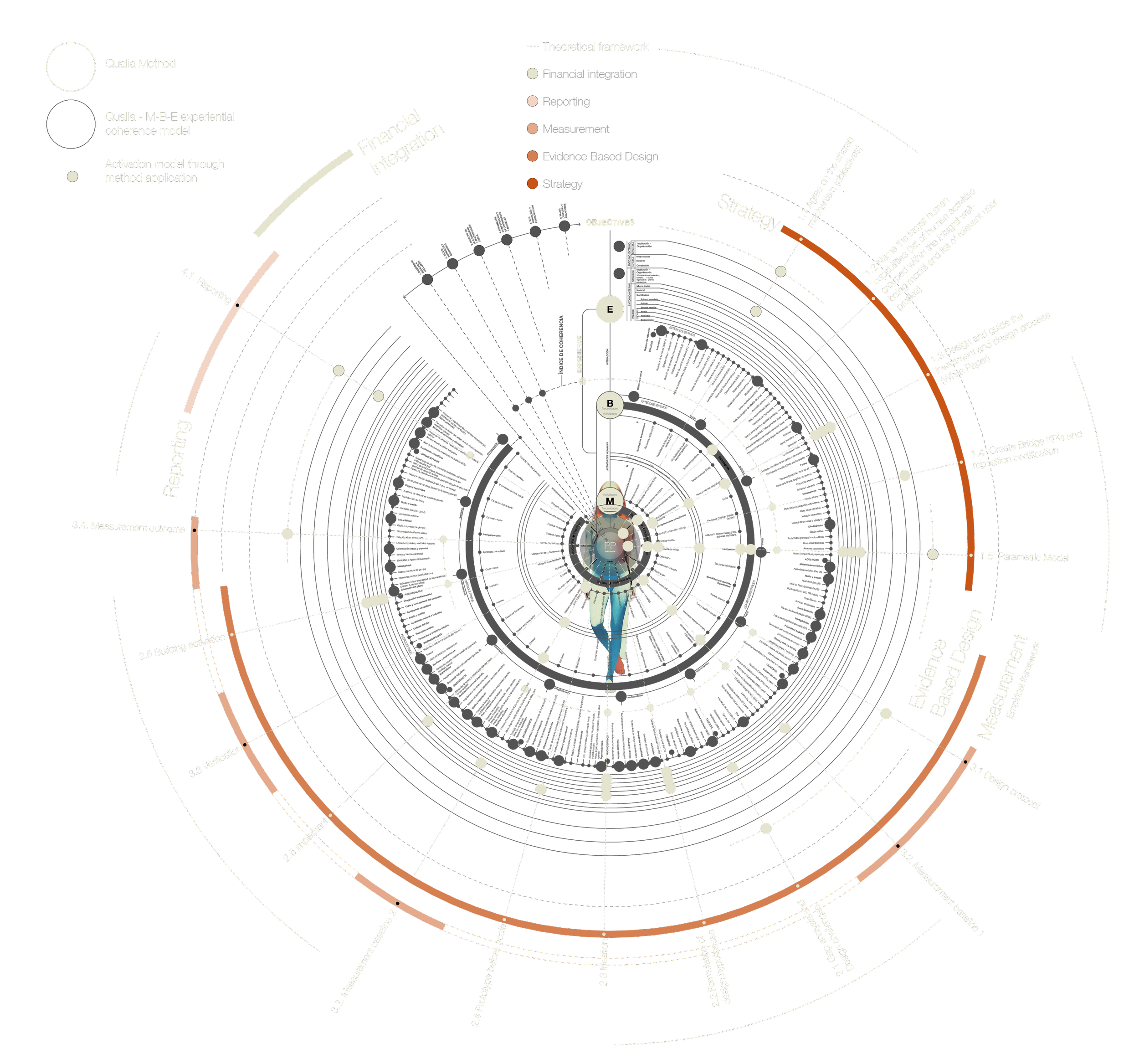
The Qualia Method is the practical pathway through which we apply our Mind–Body–Environment Experiential Coherence Model (MCE)® to real projects. While the model explains how human experience emerges within a space, the method translates that understanding into design criteria, strategic decisions, and evaluation systems applicable to organizations, buildings, and social-impact projects.
Our model is rigorously informed by multiple fields of knowledge —including environmental psychology, neuroscience, neuroarchitecture, sociology, cognitive and affective psychology, and leading contemporary models of human needs— allowing us to work with a systemic, integrative, and evidence-based perspective. This conceptual foundation strengthens the method and ensures that every decision is grounded in both scientific insight and human experience.
We start from a key premise: experience is not static.
Users change over time; environments change through use; needs vary depending on the activity; perceptions shift through habituation; and institutional objectives evolve with strategies and context. The human–environment system is dynamic and continually reconfigures itself. The Qualia Method exists precisely to accompany, structure, and bring coherence to that ongoing change.
To do this, we combine strategic analysis, evidence-based design, rigorous measurement, reporting, and financial translation. Each of these steps activates different components of the MCE —perceptual profiles, human activities, environmental stimuli, sensory systems, and project objectives— enabling design and decision-making to rely on clear, human-centered, and actionable information.
The result is a structured yet flexible process capable of adapting to highly diverse projects: from transforming workplace or educational experiences to defining standards of well-being, regeneration, or social impact for complex organizations. The Qualia Method does not aim to impose a style, but rather to ensure coherence between what a space offers, what people need, and what an institution seeks to achieve.
Qualia Team
-

Alba Méndez - Architect
FOUNDER AND CEO, Director of Development and Innovation.
Master’s in Neuroarchitecture & MBA
“My dream has always been to help elevate human well-being through spatial design. I’ve spent 20 years studying, 15 working, 4 researching, and 39 accumulating life experiences to contribute, as much as possible, to making that dream a reality.”
-
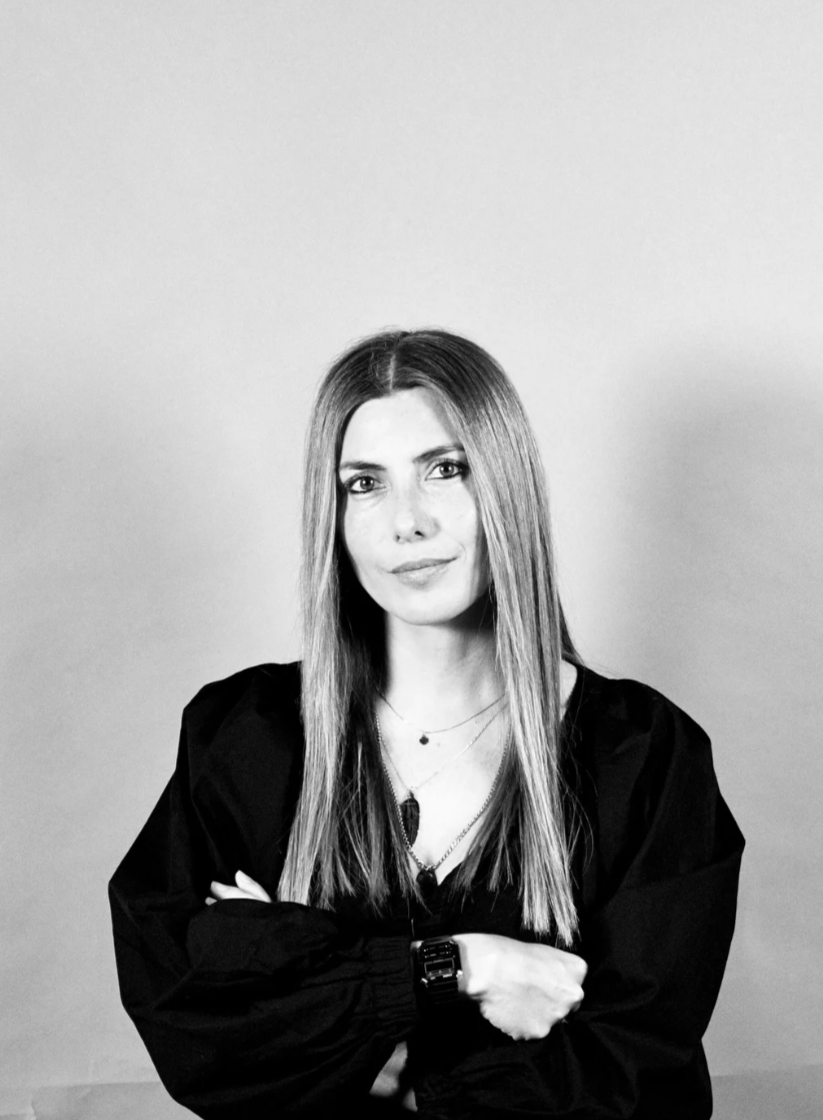
María Araya - Architect
PARTNER and Director of Research.
PhD in Architecture & Ergonomist
“I am an architect passionate about developing spaces that generate positive experiences for the people who inhabit them. Through research in neuroarchitecture, ergonomics, and evidence-based design, I strive to codify the knowledge generated so it can inform strategies and processes for conscious and healthy design.”
Collaborators
Experts
Sophie Schuller
Neurophysiologist
Felipe Dieguez
Architect
Julia del Río
Architect
Andrea de Paiva
Architect
Regular
Tomás Cano
Designer & Art Director
Architect
Tomás Fage
Cristina Martín
Architect
Verónica Martín
Interior designer
María Lleidó
Interior designer
Mariana Bollati
Architect
Where technology meets perception, and science becomes the language of human experience.

Partners & collaborating institutions